
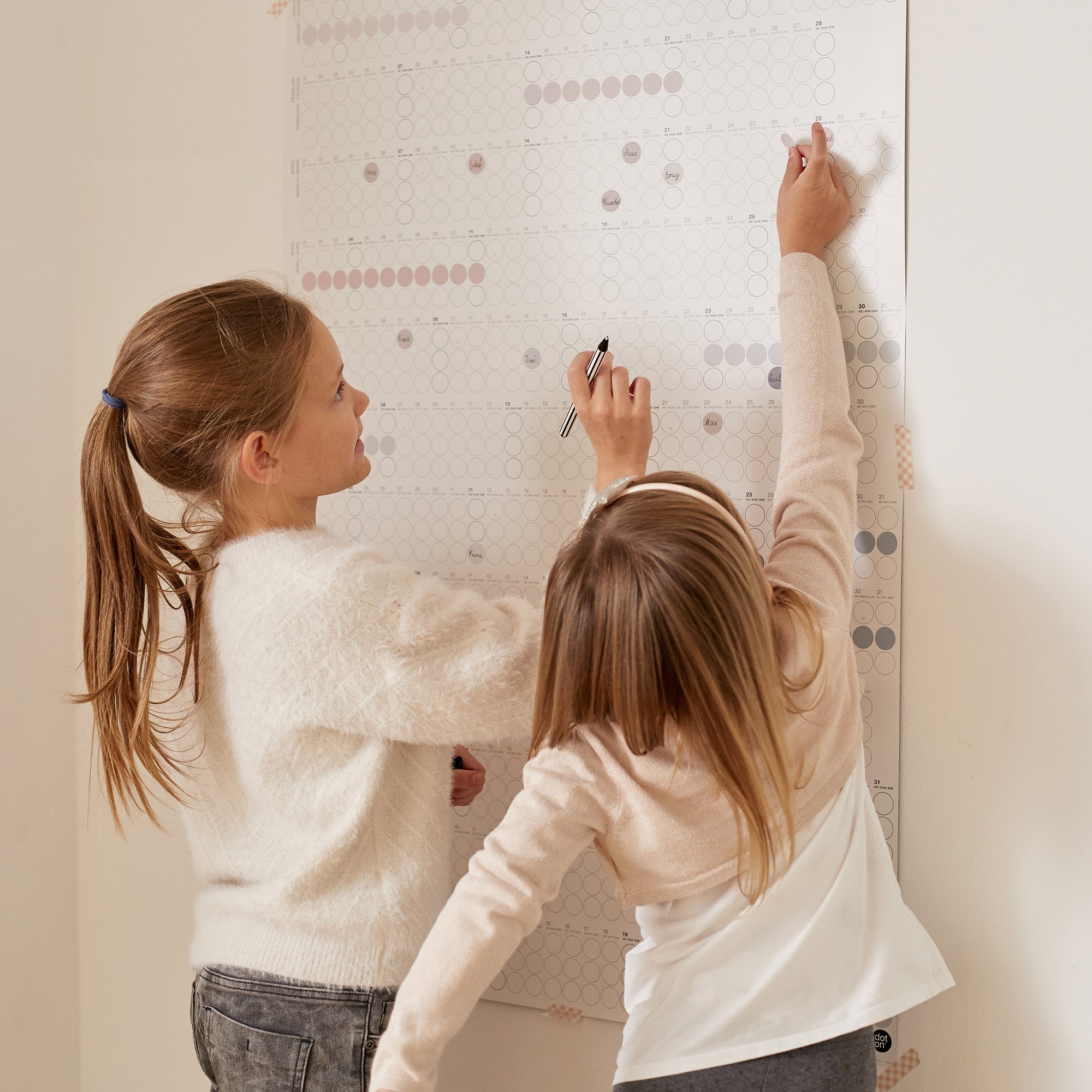
Planning as a family
How shared overview creates security, self-confidence and connection
Family life is complex.
School, daycare, work, appointments, leisure time, doctor's visits, hobbies – often everything runs in parallel.
In many families, all the planning is done by one person.
Mostly silent, mostly taken for granted, mostly invisible.
But more and more families are realizing:
Planning works better when it is shared.
And even more importantly:
Children benefit enormously from being part of the planning.
Children live in everyday life – but often without an overview
Children experience everyday family life intensely.
They sense hectic activity, time pressure, and changes.
What they often lack, however, is context .
Without visible planning, many things remain unclear to children:
-
When will Mom be here?
-
When will I see Dad?
-
How long is it until the trip?
-
Why is everything different today?
When planning only takes place in the minds of adults, children lack orientation.
Planning as a family means making time visible.
Children don't think in terms of calendar weeks or times of day.
They think in images, colors, and sequences.
When planning becomes visible:
-
Children understand processes better
-
Can they estimate time?
-
do they feel safer
A shared, visual calendar translates abstract time into something tangible.
"Ah, just two points so far – then it's the weekend."
"Here I am with Mom, here with Dad."
That creates clarity – without many words.
Why co-planning empowers children
When children are allowed to actively participate in the planning, something crucial happens:
They feel taken seriously.
This affects:
-
Self-efficacy: "I have influence."
-
Sense of responsibility: "I am part of the whole."
-
Understanding: "I know what's happening."
Planning thus becomes participation rather than control.
Planning as a relationship tool – not just as an organization
Joint planning is communication.
Conversations arise when gluing, writing, or discussing:
-
about wishes
-
about anticipation
-
about worries
-
across borders
This strengthens the connection.
Not as an aside – but quite specifically.
Why planning provides security – especially for children
Children need reliability.
Not rigid processes, but predictability .
A visible family plan:
-
shows what's coming
-
makes transitions understandable
-
reduces uncertainty
Especially during periods of change (new school, separation, illness, stressful times), planning can provide stability.
Not because everything can be planned –
but because what can be planned becomes visible .
Colors help children orient themselves.
Colors are a key to orientation for children.
For example:
-
one color per person
-
a color for school
-
a color for leisure
-
a color for special events
Children recognize their color immediately.
You don't have to read, calculate, or interpret.
One glance is enough – and the day becomes more understandable.
Learning to plan means learning to live.
When children experience how planning works at an early age, they learn:
-
Estimating time
-
Setting priorities
-
to take breaks
-
To take responsibility
Not perfect.
Not strict.
But playful and relevant to everyday life.
These are skills that have an impact far beyond the calendar.
Important: Planning should not be overwhelming.
Planning as a family does not mean:
-
Plan everything
-
Set aside every minute
-
Expect perfection
On the contrary.
A good family planner:
-
leaves room for spontaneity
-
also shows free areas
-
may be incomplete
This is how children learn:
Not everything has to be full to be good.
Conclusion: Planning is part of family culture
Planning as a family is more than just organization.
It is an expression of togetherness.
When children are part of the planning:
-
Do they feel seen?
-
They understand their everyday lives better
-
Security arises from an overview
-
Responsibility grows naturally.
Planning then becomes less of a requirement.
but rather as a shared tool for everyday life, relationships, and trust.
Would you like to plan things together as a family?
A visual, color-coded family calendar helps with this.
To make everyday life visible – and to actively involve children.


