
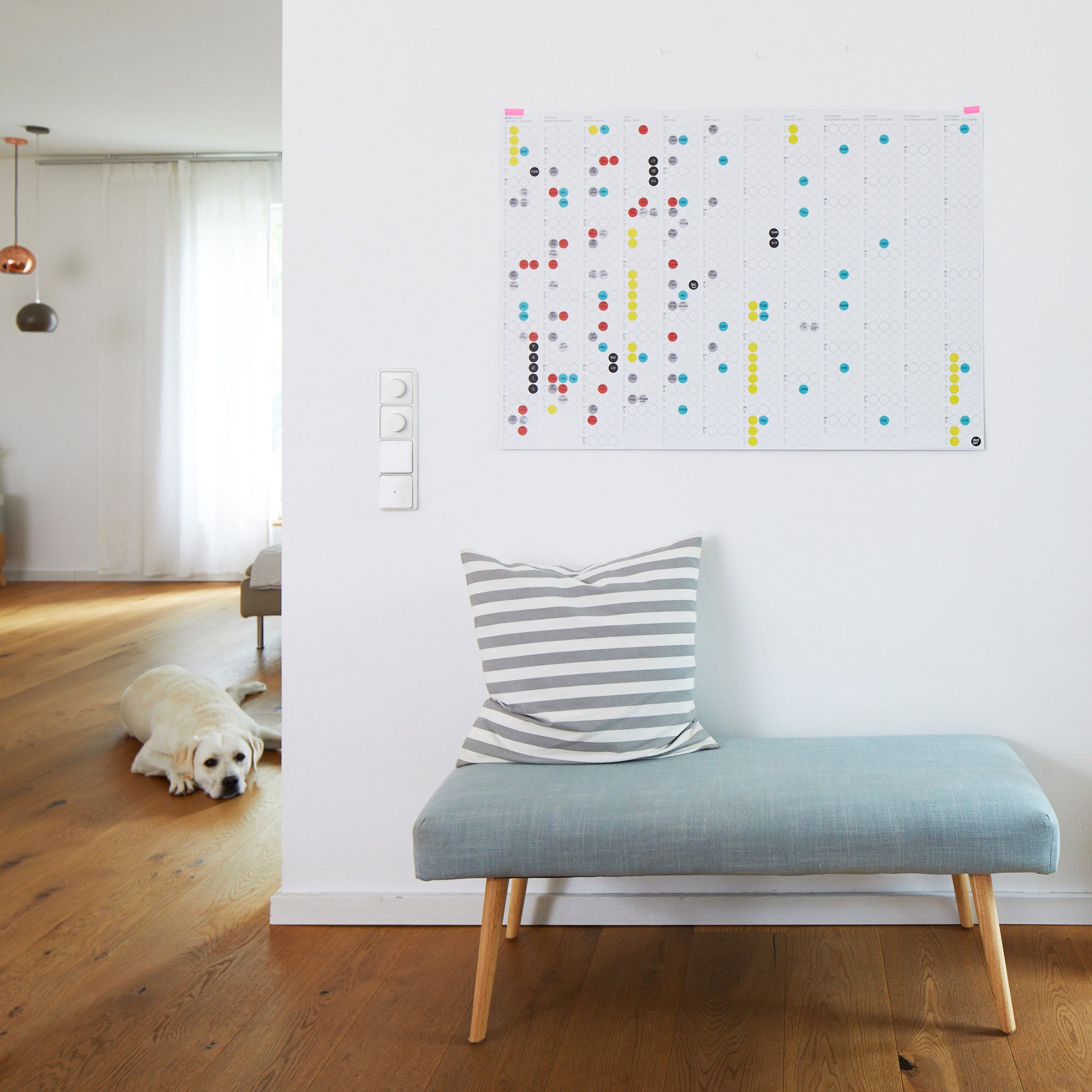
Why "me time" belongs in your calendar...
The calendar is full. So is the day, actually. Work, grocery shopping, children, appointments, household chores, meetings, birthdays, exercise, doctor's visits, and all the little things that have to be done somewhere in between.
And somewhere between all those colorful dots, there is someone else for whom, surprisingly often, no appointment is scheduled: yourself.
Yet, planning time for yourself can mean something quite different than just packing your daily routine even tighter. It is not about squeezing the maximum out of every free minute. Quite the opposite. It is about acknowledging your own time as something that deserves a place in your calendar.
We believe: A calendar shouldn't just show everything you have to do. It should also show what you can look forward to, when you can take a breath, and where time is reserved just for you.
And sometimes, all it really takes for that is a little colorful dot.

Planning time for yourself doesn't mean becoming more productive
When people think of planning, they often think of productivity first. Sorting tasks, coordinating appointments, saving time, getting as much done as possible.
That can be helpful. But planning can do something else, too: It can protect free space.
Therefore, when we plan time for ourselves, it is not about using the last remaining gap in the calendar in a "meaningful" way. It is about consciously choosing not to fill certain gaps with obligations again.
That is a small but very important difference. A free Tuesday evening doesn't automatically have to mean: "Great, then I can finally clean the basement."
Maybe it means: "Great. For once, there's just nothing."
Or: "I'm going for a walk."
"I'm reading."
"I'm meeting someone I've been wanting to see for a long time."
"I'm going to work out."
Or even: "I'll decide on Tuesday what I feel like doing."
Free time does not need to serve a purpose to be valuable.
Why our own time disappears from the calendar so quickly
Appointments with others are binding. If a doctor's appointment is in the calendar at 10 a.m., we go. If a meeting starts at 2 p.m., we are there. If the child has sports at 4 p.m., the afternoon is organized around it.
When it comes to our own time, things often look different.
"I actually wanted to read today."
"I wanted to go for a run."
"I wanted to finally meet up with my friend again."
"I just wanted to do nothing this evening."
The little word "actually" is quite revealing here. Because as soon as something else comes up, this exact time is often postponed. Tomorrow. On the weekend. When things are less busy. When everything is done.
But: When is everything actually done?
In the household, there is always something waiting. At work, there is always the next task. And in family life, something new comes up every day. Anyone who only puts their own time into the gaps that happen to be left over will eventually realize: Surprisingly few are left.
Making me-time visible: Give yourself your own color
This is where our love for dots comes into play. When you plan with colors, you give different areas of life a visual identity. Maybe blue is work. Green belongs to the children. Yellow stands for family appointments. Red marks important obligations. Why shouldn't there also be a color just for you?
Pink. Turquoise. Purple. Whatever you like. The deciding point isn't the color itself. The deciding point is: You become visible.
Planning time for yourself becomes surprisingly honest with colors
This is exactly where something exciting happens. Because colors don't just make appointments prettier and clearer; they also show patterns. Take a look at a fully planned week.
Which color dominates? How many dots belong to work? How many to the family? How many to obligations? And how many dots actually belong to you?
Perhaps you suddenly realize that five days are full of appointments – but your personal color doesn't appear once. That is not a judgment. And it doesn't mean your week is planned "wrong." It is simply information. But a very valuable one. Because what we can see, we can change more easily.
Me time doesn't have to be a whole day off
The term "self-care" quickly conjures up some pretty big images. Wellness weekend. Spa. Yoga retreat. A whole day just for myself.
Wonderful if that works out. But let's be honest: For many people, that isn't particularly realistic in everyday life. That's why we find another thought much more helpful: Me time can be small. Maybe it's 20 minutes with a coffee. A lap around the block. A chapter in a book. Half an hour in the garden. Listening to music. Taking a bath in peace. Doing something creative. Cycling. An episode of your favorite show. Or simply sitting on the couch and doing absolutely nothing.
Anyone wanting to plan time for themselves doesn't need to find three free hours somewhere first. Small islands of time count just as much.
Don't just plan appointments – plan anticipation
A calendar has a second function that we find especially lovely: It doesn't just show what's happening today. It shows what is coming. And with that, planning can create anticipation.
A dot on Friday evening can already say on Monday: Something nice is waiting for me. Maybe it's dinner with friends. Maybe an evening alone. Maybe the cinema. Maybe a hobby. Maybe finally time for a project you are really looking forward to.
This way, looking at the calendar doesn't automatically mean looking at obligations. Between all the appointments, small islands appear. And suddenly, the calendar is no longer just saying: "This is everything you have to accomplish this week."
But also: "This is what you can look forward to."
Planning time for yourself: Try the 1-dot rule
If you are currently thinking: "Sounds nice, but where should I start?" Then we'll make it very small.
Our idea: The 1-dot rule
At the start of every week, take one dot in your personal color. This dot belongs to you. Before the week is completely booked up, give it a place. Not only after everything else has been distributed. But consciously.
That can be on Tuesday evening. Sunday morning. Thursday during your lunch break. It doesn't matter. The only important thing is: This dot represents time that isn't automatically given away again.
If that eventually becomes second nature, it can turn into two dots. Or three. It's not about a prescribed amount. It's about not forgetting yourself in your planning.
Why "when I have time" usually doesn't work
"I'll do that when I have time." A beautiful sentence. Unfortunately, "when I have time" is not a particularly reliable appointment. Because free time has an astonishing quality: It gets filled. Another email here. Quick grocery trip there. The laundry could be done, too. Oh, and while we're at it...
Suddenly, it's evening. That is exactly why it can help to consciously reserve certain things. Not every minute. Not every day. But the things that are important to us. After all, we write down birthdays, doctor's appointments, and meetings. So why not a walk?
An appointment with yourself can be just as binding
Maybe it feels a bit strange at first. "Wednesday, 7 p.m.: Me time." But why, actually? If a friend had invited you to dinner at 7 p.m., you probably wouldn't decide at 6:55 p.m.: "Oh, I'd rather do the laundry instead."
With your own time, exactly that happens surprisingly often. That's why a consciously set appointment can help. Not as a rigid obligation. But as a reminder: I had set aside this time for myself.
And of course, you are allowed to change plans. A plan is not a law, after all. But if you consciously cancel your time, that is something else than accidentally filling it with other things again.
Me time and family are not mutually exclusive
Especially in everyday family life, "me time" sometimes sounds almost luxurious. Yet it is not about withdrawing from family life. On the contrary. When everyone plans visibly, personal time for every family member can also have a place. Mom has her evening. Dad his exercise. One child wants to visit a friend. The other might just need a quiet afternoon after a full week.
This creates a lovely thought: Every person in our family is allowed to have time that belongs to them. And exactly that can be made visible in the shared calendar.
Planning me time with children
Children, too, can learn early on that free time does not automatically have to be filled with a schedule. Not every afternoon needs music school, a sports club, a playdate, or leisure activities. An empty afternoon can also be a plan. Maybe there will be playing. Building. Painting. Reading. Romping around in the garden. Or simply being bored.
Even boredom doesn't have to be organized away immediately. A family planner can therefore show not only who has to be where and when, but also where consciously free spaces remain. This can give children orientation while simultaneously showing: Not every free minute has to be scheduled.
Planning me time and making the "mental load" visible
Sometimes a calendar shows something else entirely. Namely, not just how much we do – but also how many different things we keep in our heads at the same time. Schedule dentist appointment. Get gift. Wash sports clothes. Parents' evening. Grocery shopping. Plan vacation. Pay bill. Organize birthday party.
The actual task might only take ten minutes. But it has to be remembered, prepared, and scheduled. When such tasks appear visibly in the calendar, they disappear a bit from your mind. And here, too, colors help to identify burdens. Perhaps it's not the number of appointments that's the problem. Perhaps it's the distribution.
Your calendar is also allowed to show you when it's too much
When planning, we often talk about how to find free spots. At least as important is another question: When is enough actually enough?
If you use a visual calendar, you recognize full weeks very quickly. Monday full. Tuesday full. Wednesday full. Thursday full. Friday full. Saturday ...
Stop. Maybe there doesn't have to be something there, too. A free space can be a conscious decision. We even think: Empty spots are part of a good calendar. Because a calendar should not be covered with as much as possible. It should reflect your life in a way that works for you.
Planning time for yourself also means saying no
Planning doesn't just help us enter appointments. It also helps us recognize boundaries. When you look at your week and it's already full, you can evaluate a new request differently. Not: "I'll somehow squeeze this in."
But: "Where would I have to take something else away for this?" That is an incredibly helpful question. Because time cannot be arbitrarily expanded. Every new "yes" needs space somewhere. And sometimes it would take up exactly the space you had actually reserved for yourself.
In that case, the answer is allowed to be "no" for once.
Me time doesn't have to be "instagrammable"
One more important point: Your personal time doesn't have to look special to the outside world. You don't have to learn anything during it. Produce nothing. Collect zero steps. Master no new hobby. Drink no perfect matcha. And your walk doesn't have to take place at sunset, either.
If you want to spend two hours on the couch after an exhausting week, that might be exactly the right thing. Self-care is not another competition. That is why planning time for yourself shouldn't become the next optimization project.
The Sunday check: Where am I in my own week?
A nice habit can be a quick look at the coming week. Maybe on Sunday evening. Maybe Monday morning. Take five or ten minutes and look at your calendar. Not just at appointments. But at the big picture.
Ask yourself: What is going to be exhausting? What am I looking forward to? Where do I need breathing room? Where is time for me? What kind of week do I actually want to have?
Then you stick your dots. Maybe you move something around. Maybe you cancel something. Maybe you reserve an evening. With that, planning becomes something much greater than just managing appointments. It becomes a short check-in with yourself.
At the end of the month, your colors tell a story
Planning by color is especially exciting when looking back. Take a look at your calendar at the end of the month. Not at individual appointments. But at the colors. Which color do you see most often? Which one almost not at all? Were there many lovely appointments? Was there a lot of work? Did you have enough family time?
And: How often does your me-time color appear?
Perhaps the result will surprise you. That is precisely where a strength of visual planning lies: it makes abstract feelings more concrete. “The month was somehow full” suddenly becomes visible. And also: “Actually, I really did take time for myself regularly this time.”
Planning time for myself is allowed to change every week
Not every week is the same. Some are quiet. Others chaotic. Sometimes there is a lot of work. Sometimes the kids are sick. Sometimes there are birthdays, celebrations, or trips coming up. That’s why me-time doesn’t need a rigid rule. In one week, it might mean a whole afternoon off. In the next, it’s two 20-minute sessions. And sometimes it doesn’t work out at all. That, too, is part of life.
The plan should support you. Not judge you. That is important to us.
Planning is not there to squeeze as much life as possible into a week
Perhaps this is one of our most important thoughts about planning in general. A calendar is not a game of Tetris. The goal is not to fill every empty space perfectly.
Instead, planning can help you figure out: What do I really want this week?
What must happen? What is allowed to happen? What can wait? What do I consciously want to protect? And what might I not want to do at all anymore?
When we understand planning in this way, its character changes. It no longer creates pressure. It takes pressure away.
Planning time for myself: A small weekly routine with sticky dots
If you would like to try this out right away, you can plan your next week in five simple steps:
1. First, enter the fixed appointments.
Work, school, doctor’s appointments, and everything that is set in time.
2. Add household and organization.
These tasks need time, too, after all.
3. Mark family time and nice appointments.
That way, they don't get lost between obligations.
4. Take your personal color.
Now, at least one dot just for you goes into the calendar.
5. Look at the big picture.
Is there still room? Or have you filled every gap?
Done. No complicated planning system. No 25 rules. Just a bit more of an overview – dot by dot.
Maybe you don’t need more time – but more visible time
“I don’t have any time.” Almost all of us probably know this sentence. And sometimes it is simply true. Some phases of life are full. But sometimes we aren’t just lacking time. We simply no longer recognize the small windows of time that are available.
Or we don't treat them as our own time. Half an hour is quickly filled with a task. A free evening is given away spontaneously. A quiet morning is stuffed with errands. Visible planning can help to discover these small islands beforehand – and to consciously protect them.
Planning time for myself: Your calendar is allowed to be there for you, too
We love planning. But not because we believe that people should be maximally productive every day. We love it because a good overview can create calm.
Because colors provide orientation. Because a dot can remind you of something lovely. Because a calendar makes it visible when a week becomes too full. And because planning can remind us that among all the people and things for which we reserve time, we ourselves are allowed to appear, too.
Maybe it doesn’t start with a completely new daily routine. Maybe it starts very small. With one dot. Your color. And half an hour that this time doesn’t go to something else...


