
Why many people plan – but are still stressed
Planning alone is not enough. What matters is how we plan.
Many people plan ahead. They keep calendars, write to-do lists, use apps or reminders. And yet, at the end of the week, they feel exhausted, rushed, and constantly "behind" something.
What is the reason for this?
Not due to a lack of discipline.
Not due to insufficient planning.
But often it's the way things are planned.
The most common mistake: Weeks are packed full – not planned.
When we plan, we often think in terms of tasks:
-
What needs to be done?
-
What must I not forget?
-
Where else can I put something?
The result: The week is filled – but not questioned. A fully planned week feels productive. But it isn't automatically.
Visual planning often reveals something surprising:
- There is not too little time.
- There isn't enough air.
Why many people are constantly stressed despite planning.
Typical planning errors:
1️⃣ No buffer times
Appointments are scheduled one after the other.
But everyday life needs transitions.
2️⃣ No priorities
Everything is treated as equally important.
This leads to internal pressure.
3️⃣ No visible breaks
Breaks are not scheduled – therefore they do not exist.
4️⃣ Planning only for commitments
Time for oneself is completely absent from the calendar.
Stress doesn't arise from planning –
but because of poor planning.
Weekly planning done right starts with an overview
A good weekly plan answers the following questions first:
-
How much space do I realistically have?
-
Where are my peak workloads?
-
Where do I consciously need relief?
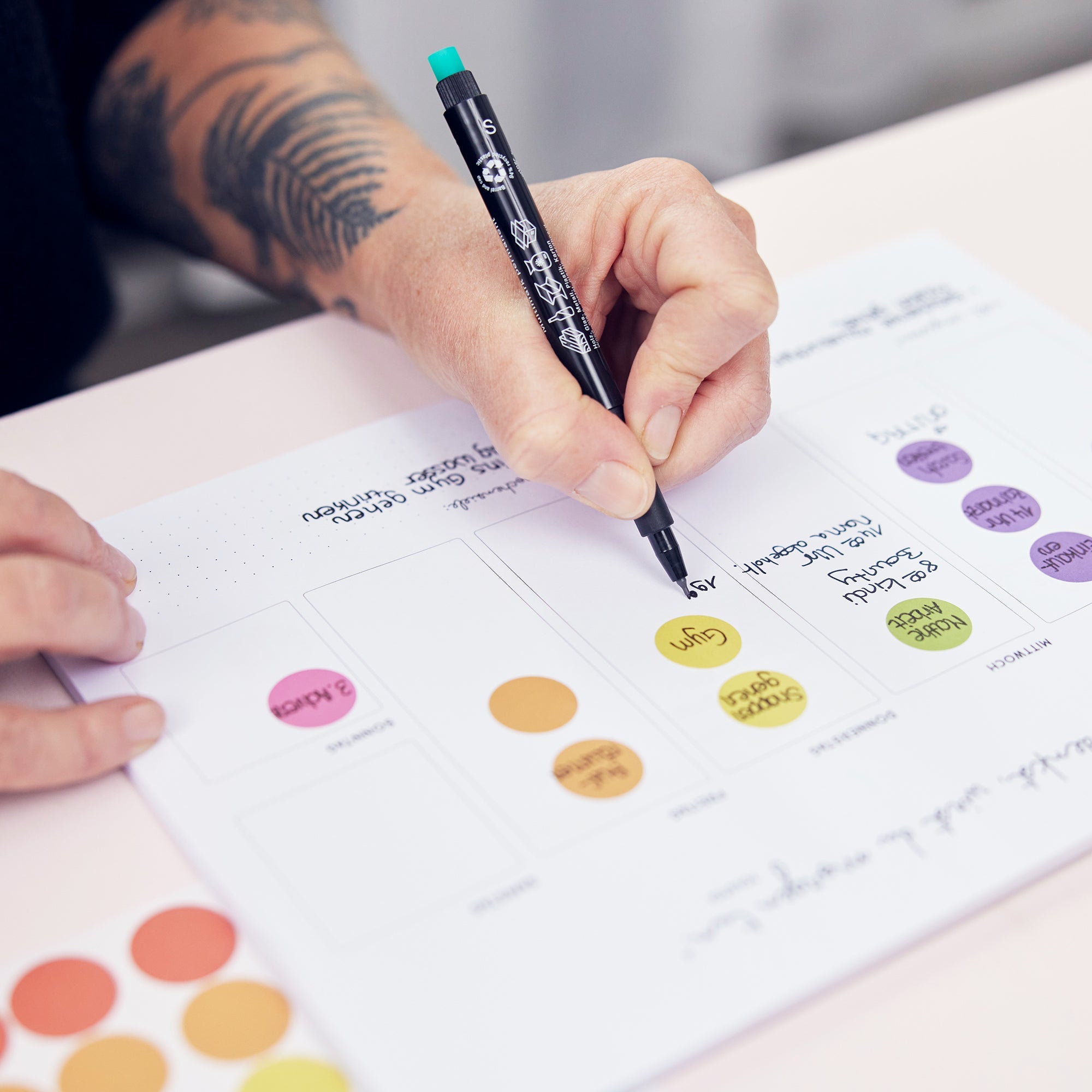
A color-coded, tactile calendar demonstrates exactly that:
-
Clusters become visible
-
open spaces stand out
-
Overload becomes tangible
And only then does real planning begin.
Why visual planning is more honest than digital lists
Digital calendars fill up quickly. One click – and another appointment fits in.
A visible weekly calendar is more honest:
-
When there's no more space, you can see it immediately.
-
When a day is overcrowded, it's immediately noticeable.
-
If breaks are lacking, it won't go unnoticed.
This honesty protects against over-planning.
Colors help to recognize balance.
Color sorting is not a design element –
It is a structural tool.
For example:
🔴 Work
🟢 Family
🔵 Leisure
🟡 Me-Time
🟣 Projects
One glance is enough – and you can see:
-
Where does the balance tip?
-
Which color dominates?
-
Which one is completely missing?
This way, weekly planning becomes not just organization – but reflection.
The most important rule: Plan less, but more consciously.
Good weekly planning doesn't mean: fitting in more.
Rather: Less – but in a targeted way.
Instead of: "What else can fit?", rather: "What is really important?"
And just as important: "What do I consciously leave free?"
Open spaces are not a shortcoming. They are recreation.
Weekly planning as a ritual rather than a reaction
Many people plan on the fly, in between other things.
We recommend:
Fixed weekly schedule – e.g. Sunday evening.
-
Get an overview
-
Setting priorities
-
Enter breaks
-
Leave a buffer intentionally
This ritual reduces stress because it replaces activity with activity.
Conclusion: Planning only works if it protects.
Planning should relieve pressure – not increase density.
If weekly planning is done correctly:
-
Clarity emerges
-
Decision stress decreases
-
Realism grows
-
Self-care becomes visible
Not everything that can be planned needs to be planned.
But everything that is planned should make sense.
Do you want to rethink your weekly planning?
With a color-coded, tactile calendar and adhesive dots, your week becomes visible – and with it, what is truly important.


