
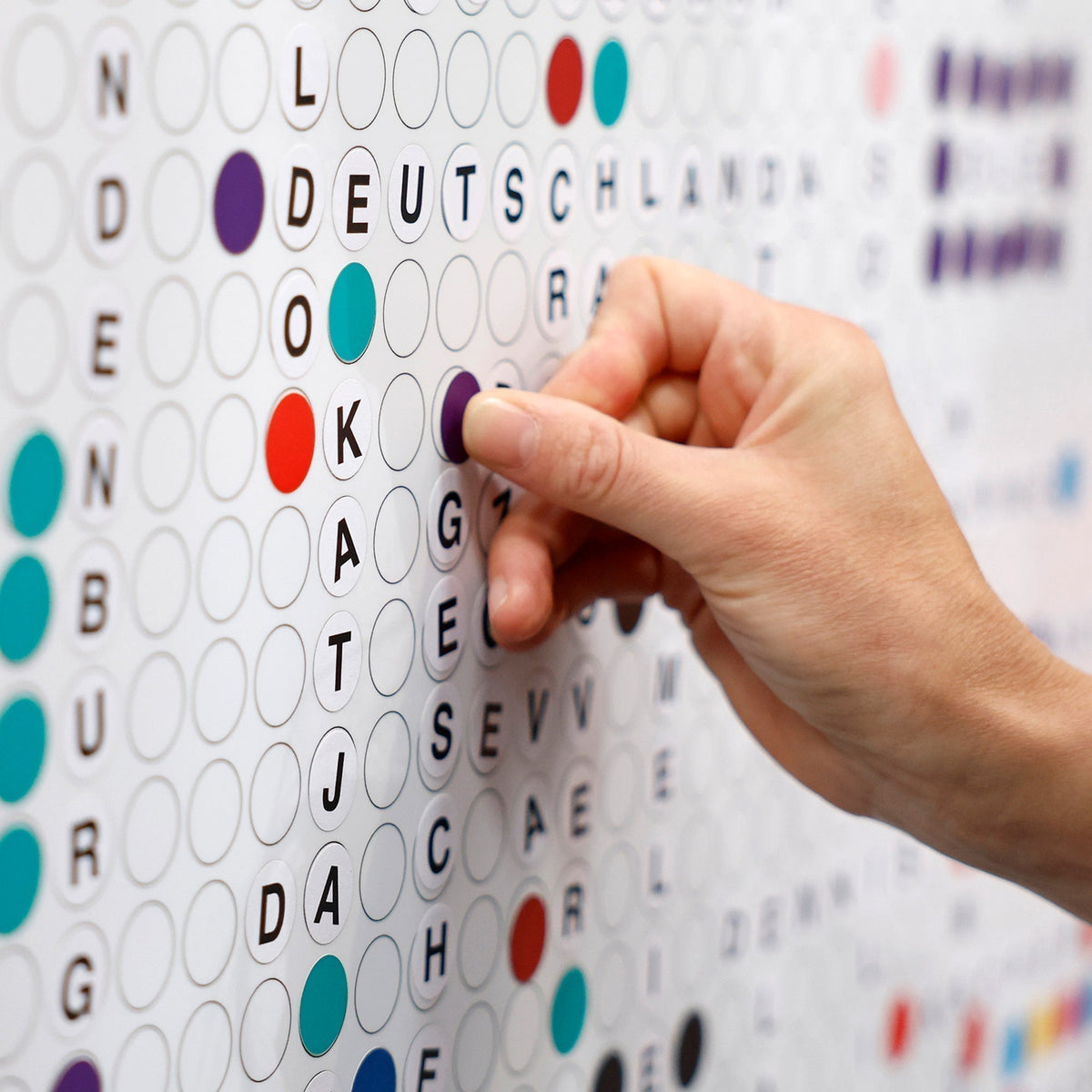
Why sticking is the better interaction
Interaction without technology – but with impact
Eco-friendly events have long been more than just a trend.
Companies, agencies, and event organizers are faced with the challenge of creating events that engage, inspire – and are responsible at the same time.
But this is exactly where a problem arises:
Many interactive event solutions are technically complex, energy-intensive, and anything but sustainable.
Yet there is a surprisingly simple alternative: sticking.
Why sustainability at events often seems more complicated than it needs to be
Tablets, apps, QR codes, voting tools – much of it sounds modern, but brings new problems with it:
-
Power consumption
-
Hardware effort
-
Wi-Fi dependency
-
Training requirements
-
Barriers for participants
What was intended as a sustainable solution quickly becomes a resource trap.
Sticking is the perfect solution – because it reduces
Adhesive-based event formats get by with surprisingly little:
-
no electricity
-
no technology
-
no apps
-
no setup
Instead:
-
cardboard instead of plastic
-
analog event walls
-
regionally produced, plastic-free materials (dots made of recycled paper or cotton, walls plastic-free cardboard)
-
ready to use immediately
Sustainability through omission, not by upgrading.
Why cardboard is often more resource-efficient than digital
Digital does not automatically mean sustainable.
Servers, end devices, and infrastructure consume energy permanently – often invisibly.
An analog event wall:
-
does not consume electricity
-
can be used multiple times
-
is recyclable
-
works anywhere
This makes it particularly attractive for:
-
Green events
-
sustainable corporate communications
-
trade fairs & conferences with an ESG focus
Inclusion is part of sustainability
Sustainability also means: everyone can participate.
Sticking is:
-
language-independent
-
age-independent
-
accessible
-
self-explanatory
No logging in.
No explaining.
No exclusion.
One dot is enough – and everyone is part of the event.
Regionally produced event ideas with adhesive dots
Some proven formats:
-
Mood barometer ("How are you feeling today?")
-
Feedback scales ("How sustainable was this event?")
-
Wish & idea walls
-
Value queries ("What is most important to you?")
All formats are:
✔ completely made of paper
✔ immediately understandable
✔ and should be displayed afterwards as a souvenir of the event
Why sticking as an interaction has a long-term effect
People do not remember technology –
they remember participation.
Sticking creates:
-
active participation
-
physical action
-
conscious decision
This stays in your head – completely without a screen.
Conclusion: More eco-friendly events do not need technology, but attitude
Sticking is not the simpler solution.
It is the better one.
Because it reduces.
Because it connects.
Because it makes responsibility visible.
And because sustainability often begins exactly where we start thinking simply again.


