
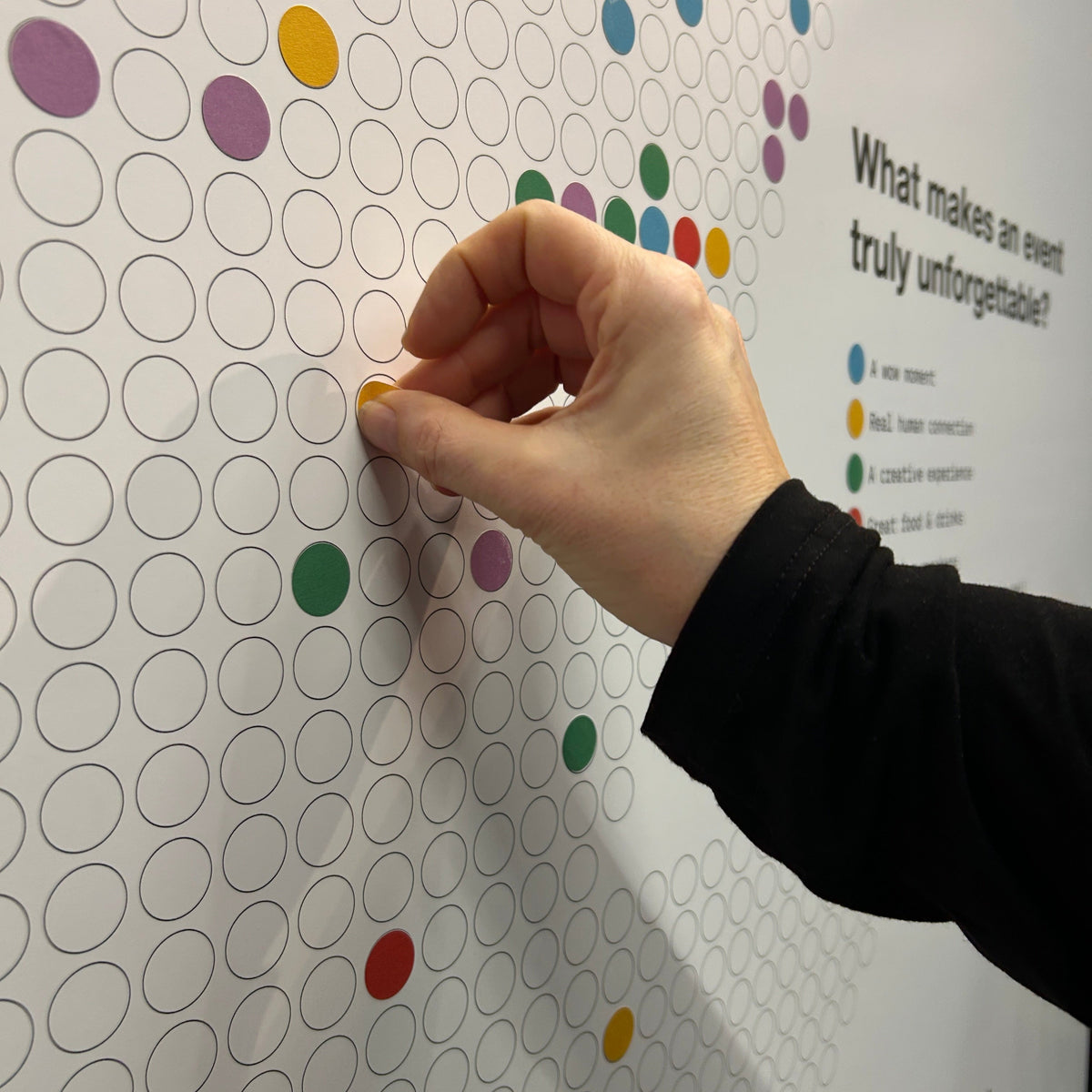
7 creative methods using adhesive dots
One question. One adhesive dot. And suddenly everyone wants to join the conversation.
Hand on heart: when was the last time you filled out a feedback form with enthusiasm? It’s probably been a while. Maybe it was after a workshop. Maybe after an event. Maybe you received an email with the subject line “Your opinion matters to us” and a link to a survey that was supposedly only going to take three minutes.
And then? Do it later. Close the tab. Forget about it.
Yet feedback is incredibly valuable. It shows what excites people, what is on their minds, what ideas they have, and where they would like to see changes.
It’s just that collecting feedback can sometimes feel surprisingly complicated. We believe it doesn't have to be that way.
What if a single question were enough to get people involved? If a colorful adhesive dot were enough instead of long forms? If opinions didn't disappear into some spreadsheet, but became visible right on the spot?
That is exactly why we at dot on love our adhesive dots.
Because they can be used to turn very simple questions into creative, interactive activities. At trade fairs, in workshops, at company parties, at conferences, or in team meetings.
And the best part: a feedback inquiry can simultaneously spark a conversation.
We’ll show you seven creative methods you can use to collect feedback – including specific questions, design tips, and ideas for evaluation.
Let's get dotting!

Why collecting feedback is often harder than you think
Actually, it’s clear: if you want to know what others think, you have to ask them. In practice, however, there is a problem. Not everyone wants to spontaneously explain their opinion in detail. Some have little time. Others don't want to speak in front of a group. Still others don't even know what they should answer. And sometimes the question is simply too complicated.
When we want to collect feedback, we therefore have to consider not only what we want to know. We should also ask: How easy are we making it for people to give us an answer? The clearer the question and the less complicated the participation, the easier the first step becomes.
Collecting feedback with adhesive dots: Why they go so well together
An adhesive dot is small. It requires no explanation, no registration, and no battery. You take it, choose an answer, and stick it in the right place. Done.
It is precisely this simplicity that makes adhesive dots so interesting for interactive feedback activities. They are suitable, for example, for voting, mood checks, prioritization, and playful questions. In addition, there is an effect that we particularly like: The result emerges visibly before the eyes of everyone involved. Every new dot changes the picture just a little bit. Individual opinions gradually turn into a shared sense of the mood. And that can pique curiosity.
What makes a good feedback question
Before we design a wall, we always first consider which answer would actually be helpful. Because a beautiful feedback wall is of little use if no one knows what to do with the result.
A good question should ideally have three characteristics:
-
It is understandable: You immediately understand what it is about.
-
It is concrete: The answer relates to a clearly defined topic.
-
It is answerable: The options provided fit the question.
“What do you think of our company?” for example, is very general. “Which topic should we delve into at our next team day?” leads to a more concrete decision. Those who want to collect feedback effectively don't start with the adhesive dots.
But rather with the right question.
1. Collecting feedback with a mood barometer wall
Let's start with a real classic. A large area. A question. A scale. And many colorful dots.
The mood barometer is a particularly simple method for quickly getting an initial opinion. The question could be:
“How satisfied are you with our workshop today?”
On the left is “Well, it's okay.” On the right is “Very satisfied.” In between lies a scale. Each person gets an adhesive dot and places it where it best fits their own assessment.
And just like that, a visible result emerges.
How the mood barometer works with adhesive dots
For this method, you need a clearly recognizable scale and enough space for the dots. You can design a horizontal line with five labeled areas or use a vertical scale.
It is important that the endpoints are clearly formulated.
For example:
1 = Not at all helpful
5 = Very helpful
This way, participants know what their position means. And the more dots that are added, the clearer the overall mood becomes.
Which questions are suitable for a feedback barometer?
Here are a few ideas:
-
How helpful was today's event?
-
How understandable was the presentation?
-
How satisfied are you with the new concept?
-
How confident do you feel in dealing with this topic?
-
How likely are you to apply what you have learned in your daily life?
We find the last question particularly exciting. Because it goes beyond a simple “Did you enjoy it?” It asks about the potential benefit.
Collecting feedback before and after a workshop
A nice variation is the before-and-after comparison. At the beginning of a workshop, ask the question:
“How confident do you feel with the topic of project planning?”
At the end, ask the same question again. Use different colors for the two points in time. For example: Yellow for before. Blue for after.
This way, you can see at a glance whether the mood has changed. It is important to note: the two clusters of dots show the development of the group, not automatically the change of every individual person. For an individual before-and-after evaluation, the answers would need to be linkable. But as a visible conversation starter, this method is wonderful.
2. Collecting feedback with dot voting
Sometimes you don't want to measure mood. But rather prepare for a decision. Maybe there are four workshop topics to choose from. Maybe a new product needs to be developed. Maybe a company wants to know which offer its customers are particularly interested in. Then a classic dot vote is suitable.
The principle is wonderfully simple: One question. Multiple options. One or more adhesive dots per person.
How to design a creative dot vote
Write the question clearly on a wall. Place the answer options underneath.
For example:
“Which topic interests you the most?”
A: Sustainability
B: Artificial Intelligence
C: Teamwork
D: Personal development
Each person receives a dot and decides on an answer. The dots are stuck directly next to the respective option. Even during the activity, it becomes apparent which topics attract the most interest.
Why dot voting is exciting at trade fairs
Imagine a trade fair booth. A large, colorful wall hangs there with the question:
“What is most important to you in a new product?”
Underneath are four answers.
- Quality.
- Design.
- Price.
- Sustainability.
Passing visitors can participate within a few seconds. It is uncomplicated and can simultaneously be a nice conversation starter. “Interesting, you voted for Design. What is particularly important to you about that?”
And suddenly, a personal conversation emerges from a single dot.
Collecting feedback with multiple votes per person
You can also assign three dots per person. Then the participants can distribute their votes. Maybe one idea gets all three dots. Maybe three different options are chosen. This variation is particularly suitable for prioritization.
However, you should communicate clearly beforehand whether several dots may be stuck on the same answer. Otherwise, the result will be harder to interpret later.
What the results of dot voting really say
Dot voting initially shows which options were chosen most frequently among the participants. It does not automatically prove which solution is objectively the best. You should also consider who actually voted.
For an open trade fair activity, for example, only people who walk by the booth and want to participate will take part. That is a valuable sense of the mood. But it is not a representative public opinion poll.
For a creative event activity, it doesn't need to be that, either.
3. Collecting feedback with a smiley wall
Not every feedback inquiry has to look serious. Sometimes it should also just be fun. A smiley wall is particularly suitable for events, family gatherings, school projects, and activities where people are intended to express their mood quite spontaneously.
The idea: Instead of a numeric scale, different facial expressions are available to choose from. From enthusiastic to rather disappointed. Each person sticks their dot on the matching smiley.
The smiley wall as a quick event check
A possible question is:
“How do you like our event so far?”
Underneath are five smileys. From very dissatisfied to very satisfied. The participants do not have to interpret numbers. They intuitively choose the facial expression that best fits.
This is particularly practical when people of different ages are participating. Children can also often understand such an inquiry well, provided the smileys are designed clearly.
Collecting feedback with humor
You can also formulate the smiley wall a bit more playfully.
For example:
“How much energy do you still have today?”
Answers:
- “Coffee, please!”
- “It’s okay.”
- “Going well!”
- “Full of energy!”
- “I could tear up trees!”
This is, of course, no scientific measurement of energy levels. But a charming interactive activity that can make people smile. And sometimes that is exactly the right entry point.
When a smiley wall is less suitable
We would not recommend this method for sensitive topics. If you want to know, for example, whether employees feel safe in the workplace or whether they have experienced discrimination, other, protected feedback channels are needed.
A public smiley wall is visible. And especially with personal or critical questions, this publicity can influence answers.
Our rule of thumb: The more sensitive the topic, the more important confidentiality and a suitable framework for the survey are. For a playful event evaluation, however, the smiley wall is a nice possibility.
4. Collecting feedback with a priority wall
Now it gets particularly interesting for workshops, companies, and teams. Because sometimes it’s not about whether something is good or bad. But rather what should happen first.
Imagine a team has collected ten ideas. All sound good. All are important. But there is only time for three. How do you decide where to start? With adhesive dots, a joint prioritization can be carried out.
How the priority wall works
Write all ideas clearly on a surface. Give each person, for example, five dots. The task is:
“Distribute your dots among the measures that we should tackle first.”
Everyone votes. Then the dots are counted. The ideas with the most votes make it onto the shortlist. This quickly provides an overview of the group's preferences.
Collecting feedback and making decisions visible
The special advantage lies in the fact that the participants experience the process directly. They see which ideas get support. They can discuss with each other. And they recognize that their opinion flows into the decision-making process.
It is important, however, to clarify beforehand what happens with the result. Is the vote binding? Does it serve as a recommendation? Or is it just a first step for further discussion? We would always make that transparent. Because participation works particularly well when people know what influence their voice actually has.
Evaluating priorities with two colors
The method becomes even more exciting with two different dot colors.
For example:
Green = This provides the most benefit.
Pink = We should tackle this as quickly as possible.
This way, participants can evaluate an idea from two perspectives. A measure can provide a lot of benefit but not be particularly urgent. Another is urgent but perhaps has only limited impact. With two colors, this difference becomes visible.
Where is a priority wall suitable?
We see many possible uses for this:
-
Strategy workshops
-
Team meetings
-
Citizen participation
-
Project planning
-
Product development
-
Association work
-
Conferences
-
Internal improvement processes
Especially when there are many ideas in the room, visual prioritization can help structure the conversation. And all this without complicated software.
5. Collecting feedback with a wish wall
So far, we have mainly worked with predetermined answer options. But sometimes we want to give people the opportunity to contribute their own thoughts. That’s where our fifth idea comes into play:
The wish wall.
It combines open-ended answers with a subsequent dot voting. This is particularly practical if you don't yet know which topics your target group is concerned with.
How the wish wall works with adhesive dots
In the first step, you collect wishes or ideas. For example, on cards or small slips of paper. The question could be:
"What do you wish for our next event?"
Everyone is allowed to write down an idea and hang it on the wall. Afterwards, similar answers are summarized. In the second step, the participants receive adhesive dots. Now they can mark which wishes they particularly support.
This creates two levels: First, an open collection of ideas. Then, a visible prioritization.
Collecting feedback without pre-defining the answers
This is the great advantage of this method. With a classic multiple-choice question, you already determine which answers are possible. With the wish wall, new thoughts are allowed to emerge. Perhaps a topic comes up that the organizing team hadn't thought of before. Perhaps it becomes apparent that many people have the same wish.
Or an idea emerges that could make an event significantly better next time.
The wish wall as a creative trade fair activity
This format can also work at a trade fair. For example, with the question:
"What feature should our next product definitely have?"
Visitors write down their wishes. Others can support them with adhesive dots. This makes the wall increasingly interesting throughout the trade fair day. It is not just a collection of answers.
It also shows which ideas receive particular attention.
How to avoid chaos on the wish wall
Open questions can quickly lead to a large number of different answers. Therefore, we would recommend a few simple rules. Formulate the question as concretely as possible. Limit the length of the answers. Summarize duplicate or very similar ideas without changing their meaning. And ensure that all contributions remain easy to read.
Then, a wild collection of scraps becomes a structured collection of ideas.
6. Collecting feedback with a two-axis matrix
Now it gets a bit more strategic. But don't worry: it remains colorful. A two-axis matrix is a great method when a single scale is not enough.
Because sometimes we want to look at two characteristics at the same time. For example:
How important is a topic?
And:
How satisfied are we with the current solution?
A matrix is perfect for exactly that.
How to set up a feedback matrix
Draw a large cross on a wall. The horizontal axis stands for importance. Left: less important. Right: very important.
The vertical axis stands for satisfaction. Bottom: not very satisfied. Top: very satisfied.
Now the participants get a dot and place it where both assessments fit together. This creates four areas. The area that is particularly interesting is:
Very important, but low satisfaction.
Because that is where topics might lie for which improvements are particularly relevant.
Collecting feedback and recognizing connections
The matrix can show more than a simple vote. Perhaps many people are dissatisfied with a topic but do not consider it particularly important. Another topic, on the other hand, is rated as very important and at the same time receives poor satisfaction scores. That can help with prioritization.
However, the question should be clearly related to a single topic. If multiple topics are to be evaluated, we recommend separate matrices or clearly distinguishable colors with a legend. Otherwise, the analysis quickly becomes confusing.
Which events is this method suitable for?
A two-axis matrix is particularly well-suited for:
-
Strategy workshops
-
Product feedback
-
Internal team events
-
Conferences
-
Innovation formats
-
Customers
-
Project retrospectives
It requires a bit more explanation than a smiley wall. In return, it can provide a more nuanced mood picture.
Using the matrix as an icebreaker
We wouldn't just photograph the results and tick them off. The question "Why are so many dots placed exactly there?" is more exciting. Perhaps there are different expectations. Perhaps participants understand the topic differently. Perhaps a new idea arises.
The dots initially show where opinions cluster. The conversation helps to understand why.
7. Collecting feedback with an interactive event wall
And now we come to one of our favorite ideas. Because feedback can be more than just informative. It can also look really beautiful. With an interactive event wall, the participation itself becomes part of the design. People stick dots, make decisions, or answer questions. And the wall changes during the event.
The result can be a colorful pattern, a visible mood picture, or an individually designed installation.
When feedback becomes a participatory activity
Imagine a large wall at a corporate event. It says: "What makes our team special?" Below it are several areas.
- Cohesion.
- Creativity.
- Courage.
- Reliability.
- Humor.
Each person gets an adhesive dot and chooses the term that fits them best. During the event, the areas fill up. A shared picture emerges of which qualities employees associate with their team.
And quite incidentally, people start talking to each other.
Collecting feedback with a visual surprise effect
The design can go a step further. Perhaps the answer areas together form a large graphic motif. Perhaps the dots create colored areas. Perhaps many individual contributions turn into a special message. It is important to us to distinguish between two things.
A classic feedback wall should make answers as clearly visible as possible. A pixel art wall often mainly pursues the goal of letting a motif emerge together. Both can be creatively combined with each other. But the design should always fit the actual purpose. If a question is to be evaluated, the assignment of dots to the answers must remain clear.
Why we love individual feedback walls
No two events are the same. A trade fair has different goals than a company party. A workshop needs different questions than a customer event. That's why we find individual concepts particularly exciting. The question can be tailored to the target group. The design can incorporate the company's colors.
The format can fit the event space. And the entire campaign can become part of a larger story. At dot on, we develop suitable adhesive formats for this together with companies and organizers. From feedback polling to large-format participatory installations.
Collecting feedback at trade fairs: How to invite visitors to participate
At trade fairs, many impressions compete with each other. People walk through the halls. Everywhere there are products, conversations, presentations, and advertising messages. Those who want to win attention, therefore, need a good entry point. An interactive question can be exactly that.
For example:
"Which trend will change your industry the most?"
The possible answers are clearly visible on a wall. Next to them, the adhesive dots are ready. Participation only takes a few seconds. And suddenly, there is a reason to stop.
The best trade fair question is immediately understandable
We would choose particularly simple questions for trade fair campaigns. No long explanations. No complicated technical terms. No ten answer options. Instead, a question that can be grasped while just walking by.
For example:
"What is most important to you with sustainable products?"
Or:
"Which challenge is currently occupying your team the most?"
The closer the question is to the interests of the target group, the more likely a meaningful conversation will arise.
Collecting feedback without putting visitors under pressure
Not everyone who sticks a dot wants to have a sales conversation afterwards.And that is perfectly fine. We would therefore consciously design participation to be open. Those who only want to stick a dot are allowed to do so. Those who become curious can ask questions. Those who want to strike up a conversation get the opportunity to do so. This keeps the campaign pleasant.
And for us, that is an important difference between a good participatory idea and an unpleasant sales ploy.
Collecting feedback at company parties: Looking back on the year together
Company parties also offer wonderful opportunities for creative feedback queries. However, the question should fit the atmosphere. At a Christmas party, most people probably don't want to spontaneously fill out an extensive employee questionnaire. A playful retrospective question, however, can work well.
For example:
"What was your highlight this year?"
Or:
"What are you particularly looking forward to next year?"
The answer options can pick up on various projects, successes, or future topics. This creates a shared retrospective. And perhaps even one or two beautiful memories.
Collecting feedback as part of the corporate culture
Especially with company events, participation can be more than just a single campaign. It can show: Opinions are welcome. Different perspectives have a place. And decisions are not prepared exclusively behind closed doors.
Of course, an adhesive wall does not replace good internal communication. But it can be a visible part of it. Especially if the company subsequently makes it transparent what came of the results.
Collecting feedback in workshops: A dot can structure discussions
In workshops, there are often many opinions. That's good. But sometimes it is primarily the people who like to express themselves quickly who speak. Others think first. Or they don't want to justify their assessment in front of the whole group. A silent dot voting can be helpful here.
Everyone gets time to look at the options. Then the sticking begins. Only then does the discussion begin. This gives every participant the opportunity to make their own decision first.
Why silent voting can make sense
When people express their opinion out loud immediately, early contributions can influence further discussion. A silent vote can help to first make different perspectives visible. However, even a public dot wall is not completely uninfluenced. Whoever sticks later possibly already sees the decisions of the others. If independent answers are particularly important, you can therefore conduct the vote covertly first and only make the results visible together afterwards. That is a bit more effort. But it makes sense for certain questions.
Collecting feedback in team meetings: Small queries, great clarity
Not every feedback campaign needs a big event. Adhesive dots can also be helpful in everyday team life. For example, in a weekly review.
Ask three questions:
What went well?
What slowed us down?
What should we change next week?
Collect short answers first. Afterwards, each person marks the topics they find particularly important with dots. This way, the team can identify which points should be worked on further together. This also works in small groups.
And sometimes it takes nothing more than a sheet of paper, a few cards, and a handful of dots.
Collecting feedback: How to plan your adhesive dot campaign
A good feedback campaign doesn't start only when the first guests stand in front of the wall. A bit of preparation makes a big difference. We would therefore proceed in seven steps.
Step 1: Define the goal of your feedback query
What do you want to find out? Is it about satisfaction? Interests? Wishes? Priorities? Or do you primarily want to create an entry point for conversation? This decision influences everything else.
An entertaining trade fair question needs a different format than an important internal prioritization.
Step 2: Formulate a clear question
The shorter, the better. At least for spontaneous event queries. People should understand the question without a long explanation. Also avoid multiple questions in one sentence.
"How satisfied are you with the event and would you recommend it?" are, for example, two different things. It is better to turn them into two separate queries.
Step 3: Decide on suitable answer options
Consider which answers are actually viable. Are the options clearly distinguishable from one another? Is an important possibility missing? Is an "Other" field needed? Or one for "I can't judge"? This preparation is crucial, especially for votes. Because people can only choose what you offer.
Step 4: Choose the appropriate dot sticker method
Now comes the design. A scale is suitable for a simple satisfaction question. A dot vote is good for multiple options. A wish wall for free ideas. And for a large event, perhaps an individually designed feedback installation. It is important that the form of the query supports the goal. Not the other way around.
Step 5: Set the voting rules
How many dots does each person get? Can they place multiple votes on the same answer? Is participation anonymous? Will the results be shown during the event?
The clearer the rules, the better the result can be interpreted later.
Step 6: Include the evaluation in your planning from the start
This is where it gets important. If you need numbers after the event, you should design the wall so that the dots can be counted reliably. A clearly defined field per answer helps with this. Likewise, a clear legend. And a photo of the finished result.
For extensive queries, it may make sense to document the votes in a table afterward as well.
Step 7: Show what became of the feedback
This is perhaps the most important step. People give their opinion. But what happens afterward? If you want to collect feedback, you should also provide feedback on the results if possible. Perhaps you publish the three most chosen topics. Perhaps you explain which ideas will be implemented.
Perhaps you show what has changed at the next event. This is how a one-time stickering activity becomes a tangible participation process.
Collecting feedback with dot stickers: What size makes sense?
The size of the dot stickers also plays a role in the design. Smaller dots are suitable for short lists, compact votes, or planning overviews. On larger walls, highly visible dots are often more practical. The decisive factor is that the dot stickers match the size of the answer fields.
In addition, there should be enough space for many votes. Because if all fields are completely covered after twenty participants, further voting becomes difficult. We would therefore always plan based on the expected number of participants.
Why we at dot on love feedback with dot stickers so much
For us, dot stickers are much more than colorful paper circles. They can make things visible. They can create order. They can stimulate creativity. And they can connect people to one another. That is exactly what happens during a successful feedback activity.
One person sticks their dot. A second one stops. A third asks about it. Someone is surprised by the result. Someone else explains why they chose a certain answer. And suddenly a conversation arises that might never have taken place without the wall.
That is what is special to us about analog participatory formats. A dot is small. But it can be the beginning of something bigger.
Conclusion: Collecting feedback can be simple – and fun
Collecting feedback does not have to be complicated. It does not always have to be a long questionnaire. And it does not always have to take place digitally. Sometimes a well-formulated question is enough.
A clear wall. And a colorful dot sticker. Whether it's a mood barometer, dot vote, smiley wall, priority wall, wish wall, two-axis matrix, or interactive event installation: each of these methods offers a different way to make opinions visible. The only important thing is that the method fits the question. That people understand what it's about. And that the results aren't simply forgotten afterward.
Because in the end, it’s not about collecting as many dots as possible on a wall. It’s about giving people a voice. And doing something with their answers.
We think: That is something worth sticking with.
Turn feedback into a real participatory moment
Would you like to collect feedback at your next workshop, trade fair, or company event that is not only collected but also becomes visible and tangible? Then discover our colorful dot stickers or let yourself be inspired by our individual event formats.
Together, we will find an idea that fits your question, your target group, and your event.


